



-
Temple of the Tooth
-
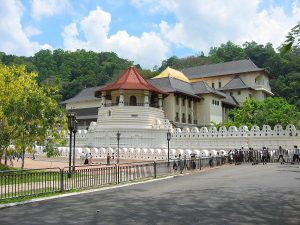
The main attraction of the city and also the most sacred Buddhist establishment in Sri Lanka is where one of Buddha’s Tooth is being kept. Built in the 16th century but improvements and additions have been done to this structure until the fall of the Kandy kingdom. A golden canopy was added recently. Daily rituals are being carried out at various offering times to the shrine. A dress code applies for entering the temple. The magnificence has been enhanced by the octagonal pavilion.
-
Kandy Lake
-
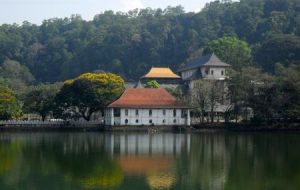
The construction work of this man built lake was commenced in 1807 and completed in 1812 by King Sri Wickrama Rajasinghe. This area had been a paddy field previously and is said to be suggested by Captain Davy to create an artificial lake by traping water streams flowing from nearby areas.
-
Peradeniya Botanical Garden
-
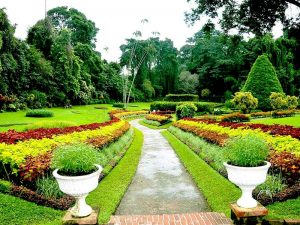
Royal Botanical Garden, Peradeniya is located in close proximity to the city of Kandy, which is the last kingdom of Sri Lanka and it is the capital of central province. And also Peradeniya botanical garden is near to Mahaweli River which is the longest river in Sri Lanka. The location and the environment of the garden are matching to spend a leisure time and it is a fantastic place to attract the tourists. Peradeniya garden is 110km from Colombo and nearly 6km from Kandy. Also the garden is located by Kandy – Colombo main road which is known as A1.
It is renowned for the collection the variety of Orchids,and has more than 300 varieties of Orchids, spices, medicinal plants and palms trees attach it is the National Herbarium. Total land mass of the botanical garden is 147 acres, 460 Meters above sea level with a 200 day annual rain fall.
-
Royal Palace of Kandy
-
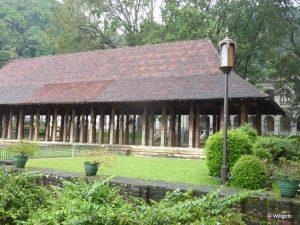
Old place buildings are just beside the temple of the tooth. Among them are the old royal palace, quarters of the royal concubines; queen’s chambers the council chambers and the armoury. Some of these are now being used as museums depicting the exhibits of the Kandyan era. The council chambers built in 1784 is a unique example of wooden architecture of the Kandyan period. The Kandyan Convention was signed here ceding the country to the British in 1815.
-
Knuckles Mountain Rage
-
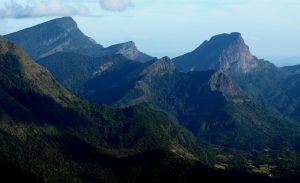
The Knuckles Mountain Range lies in central Sri Lanka, north-east of the city of Kandy. The range takes its name from a series of recumbent folds and peaks in the west of the massif which resemble the knuckles of clenched fist when viewed from certain locations in the Kandy District. Whilst this name was assigned by early British surveyors, the Sinhalese residents have traditionally referred to the area as Dumbara Kanduvetiya meaning mist-laden mountain range (Cooray, 1984). The entire area is characterised by its striking landscapes often robed in thick layers of cloud but in addition to its aesthetic value the range is of great scientific interest. It is a climatic microcosm of the rest of Sri Lanka.
-
World Buddhist Museum
-
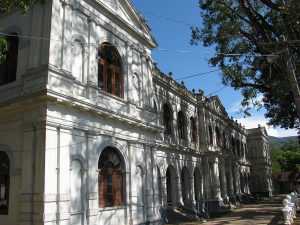
International Buddhist Museum is the world’s first International Buddhist Museum.[1] It is located next to the National Museum of Kandy and Temple of the Tooth in Kandy, Sri Lanka. The site was the former Palace of the Kandian King, Wimaladharmasuriya,[2] upon which the British constructed a Victorian era building, which housed the Kandy Kachcheri.
The museum was established with the contributions of 17 countries such as Sri Lanka, India, Bangladesh, Nepal, Pakistan, Japan, China, Korea, Indonesia, Thailand, Myanmar, Laos, Vietnam, Cambodia, Malaysia, Bhutan, and Afghanistan.
-
Hanthana Mountain Range
-
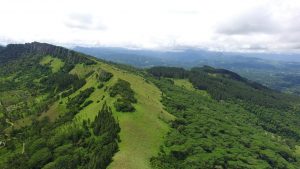
Another attractive place you can visit in central province is Hanthana Mountain Range which is near to Kandy. The Hanthana Conservation Forest is another name for the mountain range where you can experience the Sri Lanka’s bio diversity very purely. This is governed by Department of Forest Conservation. Under the National Environmental Act, the Hanthana mountain Range was published as an environmental protection area in 2010. There are 7 mountains in the mountain range and the maximum height is 3800 ft. The highest mountain is known as Uura Kanda. The mountain range is very popular among the mountain hikers in Sri Lanka as well as the foreign visitors. Annually a number of visitors are coming to Hanthana mountain range and collecting beautiful memories for their lives. Don’t forget to bring your camera when you are visiting Hanthana since in there also you can see the glory of the Sri Lanka’s nature. Not only the birds and butterflies but also you can see various types of wild flowers, insects, wild trees and many more things.
-
Udawattha Kale Sanctuary
-
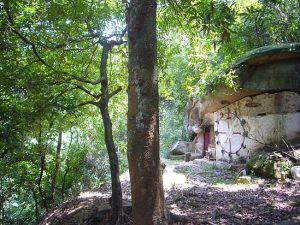
Udawatta Kele Sanctuary or the Royal Forest Park of Kandy is situated on the hillside behind the Dalada Maligawa or the Temple of the Tooth Relic. This forest extents about 257 acres and is considered to be a vital Bio reserve for the much populated Kandy City. Centuries back, area surrounding Kandy had been a Rain Forest and the human settlements took place during the era of King Panditha Parakramabahu (1302-1326 AD) and in 1371 AD, King Wickramabahu made Kandy his Kingdom. During this era Kandy was called as “Senkadagala”. This name came into being due to a Brahmin named Senkanda, who lived in a cave at Udawattakele during that era. During the Kandyan Kingdom, this forest area behind the palace was called ” Uda wasala watta” or the ‘Upper Palace Garden’ frequented by the royalty and was out of bound to the people.
-
Royal Palace Park
-
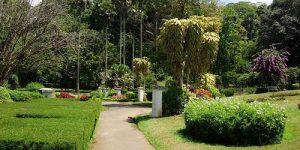
The Royal Palace Park, commonly known as Wales Park is a small park on top a small hill in the heart of the city of Kandy, that overlooks Kandy Lake and most of the city. Established by King Sri Vikrama Rajasinha of Sri Lanka it has been renamed as the Wales Park in honor of the Prince of Wales by the British.
Herbert Wace, Mayor of Kandy was restored this site that was neglected, and built a park in 1887
-
Embekke Devalaya
-
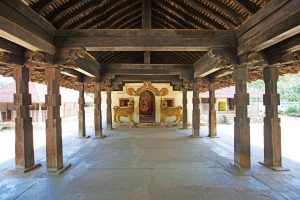
The main attraction is the intricate wooden carvings of this 14th century shrine dedicated to God Kataragama. There is also a Buddhist temple on location. Almost the entire structures of some wooden buildings are decorated with dancers, musicians, wrestlers, legendary beasts and birds. Nearby are the ruins of an ancient rest house with similar pillars carved in stone.
-
Bahirawakanda Temple
-
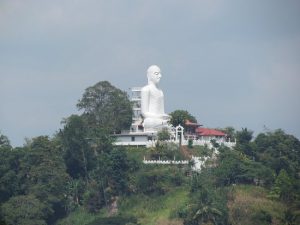
Rising up above the Kandy town it’s just 2 km from the Dalada maligawa the temple of the Sacred tooth relic. The name “Bahirawa Kanda” means the gnome mountain. There are many beliefs in folklore pertaining to the ancient history of this mountain.
According one legend there was a powerful Bahirawa Devalaya at the top of the Bahirawa Kanda where hundreds of beautiful girls had been sacrificed to Bahirawa Deviyo. These Devalayas and Kovils flourished during the days of Nayakkar Kings.
-
Degal Doruwa Rajamaha Viharaya
-
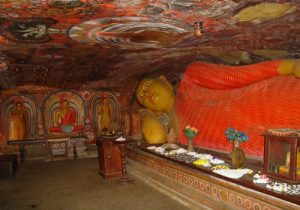
The Degaldoruwa Temple was built in 1771 AD by King Rajadi Rajasinha and was initiated during the rein of his elder brother King Kirti Sri Rajasinha [1747-1782 AD].This is considered as a Cave Temple with Kandyan era Paintings and Architecture.
This temple is situated at Amunugama, a village near Kandy Town.The easiest way It can be reached from Kandy is via the roadway over Lewella Bridge or by proceeding along Kundasale road and turning left at Nattarampota.
-
Lankatilaka Temple
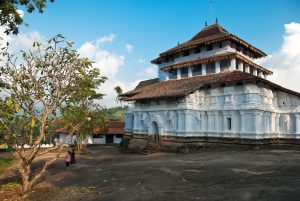
Monastary on a rock, Kandy, Sri Lanka
Located at Udunuwara Hiyarapitiya village of Kandy is the famous temple of Lankatilaka. The huge rock where the temple was built is called as Panhangala Rock. Being one of the three famous ancient temples near Peradeniya, one can reach the Lankatilaka Viharaya along Kandy -Colombo Main road and turning to left from Pilimatalawa [near 104 km post] along the Daulagala road leading to Hiyarapitiya village. It is about four kilometers from this turn off.
-
Gadaladeniya Temple
-
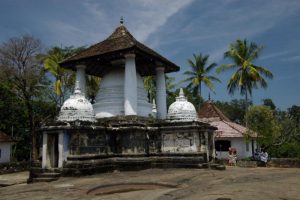
This 14 century temple is situated about 15Km from the town. The structure of the temple is influenced by the South Indian architecture and built on a rock. The stupa is on a high stone platform.
-
Galmaduwa Temple
-
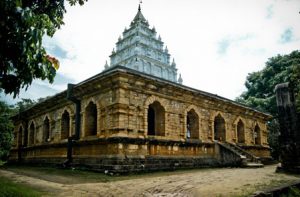
A short turn off from the Kundasala Road just outside of Kandy and you will come upon a strange sight: the unfinished Galmaduwa Viharaya. Traditionally ascribed to King Keerthi Sri Rajasinghe, it is said that while this building was being completed the king heard of the discovery of a cave at Degaldoruwa and stopped the work on Galmaduwa shifting his attention to Degaldoruwa. Sadly, in its unfinished state, this building was never used as a temple.
The Galmaduwa viharaya is an impressive building of strange architecture. As its local name suggests, it is basically a pavilion built of stone and brick. But a high gopuram gives it a Hindu identity. There is an ad mixture of Tamil-Hindu influence within the Buddhist place of worship.